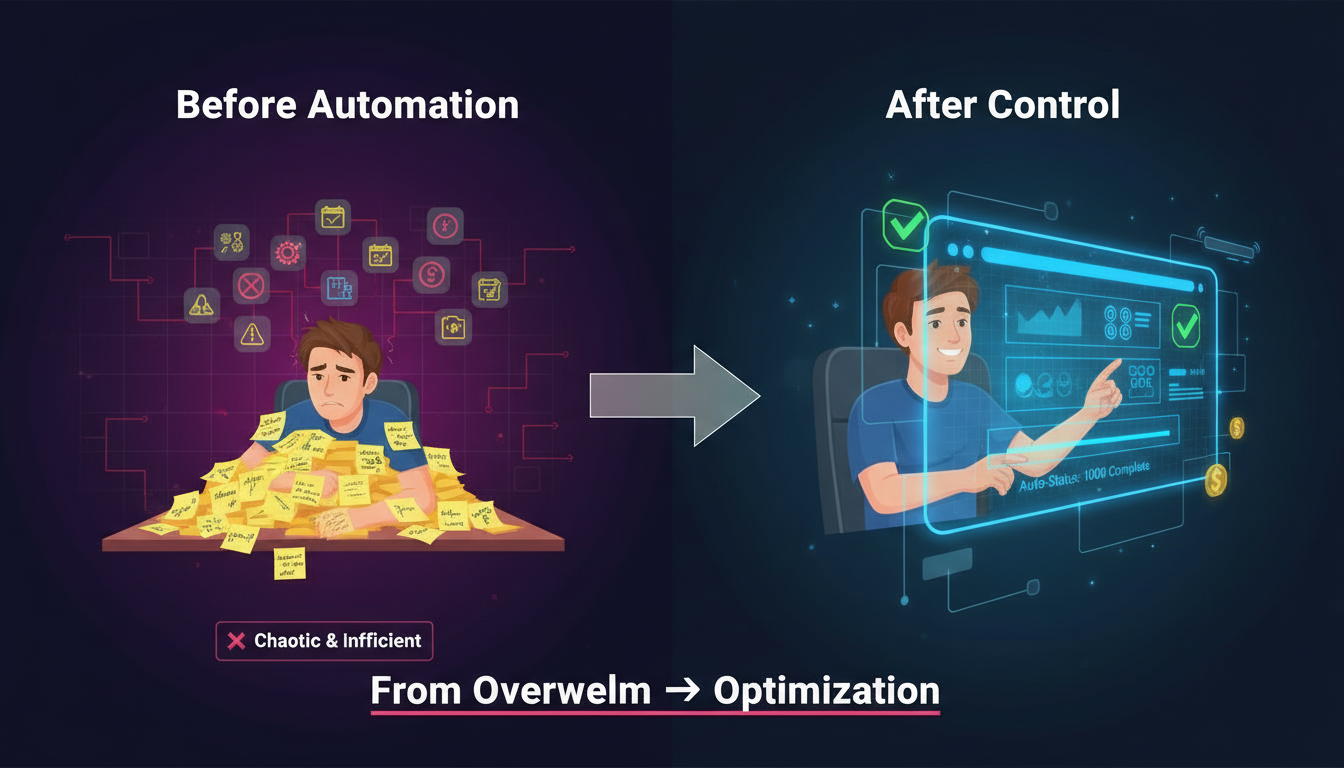

Many businesses operate in a constant state of chaos. Tasks are tracked in scattered tools, approvals depend on reminders, and teams spend more time managing work than doing meaningful work. Growth feels stressful instead of exciting.
An automated business looks very different.
Automation isn’t about replacing people—it’s about creating control, clarity, and consistency. This article explains what an automated business actually looks like, how it operates day to day, and why moving from chaos to control is essential for sustainable growth.
What “Chaos” Looks Like in Growing Businesses
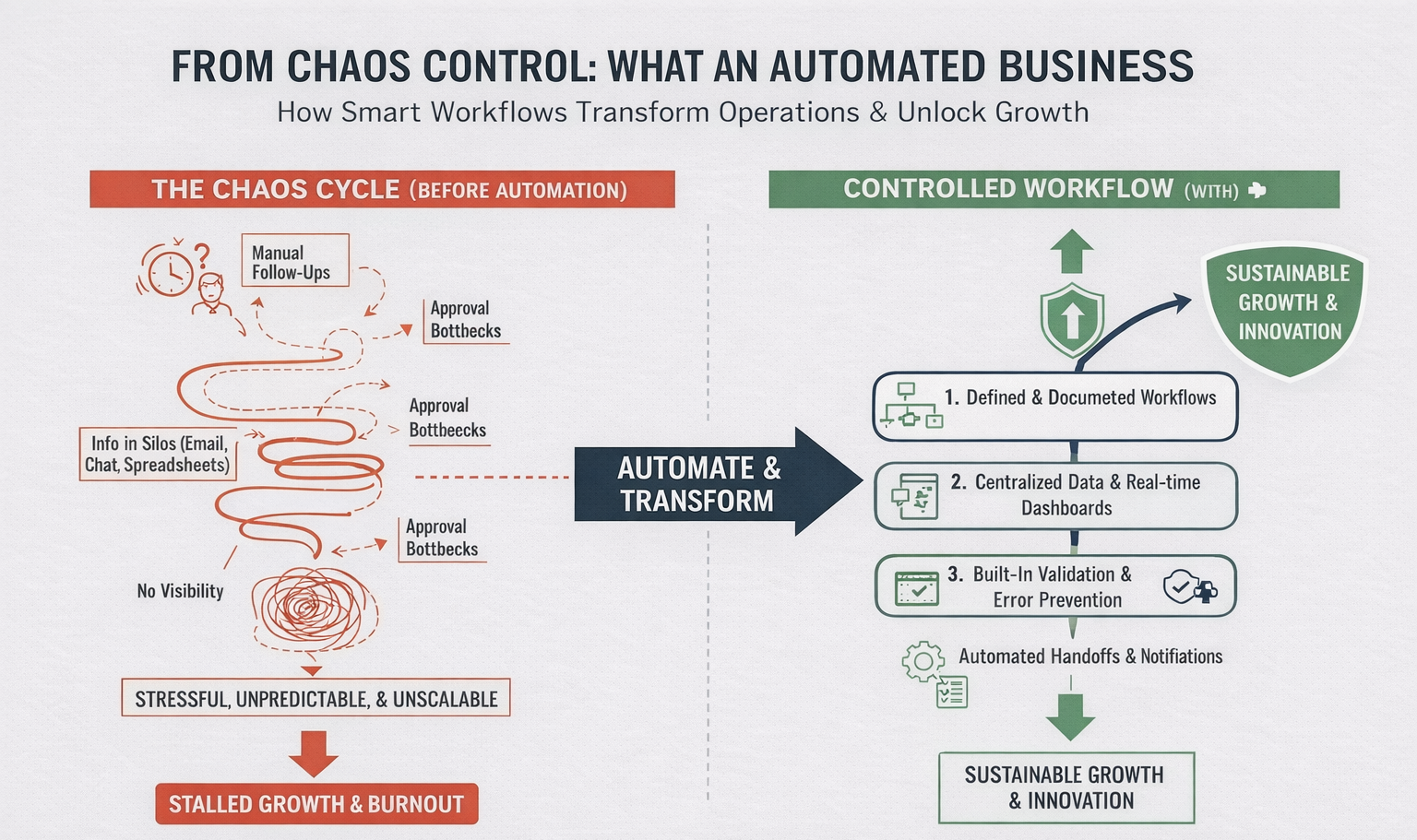
Before automation, many organizations experience similar problems:
- Tasks depend on manual follow-ups
- Information lives in emails, chats, and spreadsheets
- Work slows down when key people are unavailable
- Errors repeat because processes aren’t standardized
- Leaders lack real-time visibility into operations
This kind of chaos doesn’t come from bad employees. It comes from manual, unstructured workflows that don’t scale.
What Changes When a Business Becomes Automated
Automation introduces structure where chaos once existed. Work no longer relies on memory, reminders, or individual habits.
Clear and Predictable Workflows
In an automated business:
- Every task follows a defined path
- Responsibilities are clearly assigned
- Handoffs happen automatically
- Nothing gets “forgotten”
This creates confidence across teams and eliminates constant check-ins.
Centralized Information and Visibility
One of the biggest shifts automation brings is visibility.
Data Lives in One System
Automated businesses centralize information so that:
- Files are easy to find
- Status updates are visible in real time
- Reports update automatically
- Leaders can see progress without asking
This reduces confusion and speeds up decision-making.
Fewer Errors, More Consistency
Built-In Rules and Checks
Automated systems:
- Enforce required steps
- Prevent incomplete submissions
- Reduce duplicate work
- Maintain consistency across teams
As a result, quality improves without adding more oversight.
Teams Focus on High-Value Work
When repetitive tasks are automated, employees gain time and mental space.
Less Busywork, More Impact
Instead of spending hours on manual updates, teams can focus on:
- Strategy and planning
- Customer relationships
- Problem-solving
- Growth initiatives
This leads to higher job satisfaction and better performance.
Automation Improves Speed Without Pressure
Automated businesses move faster—not because people work harder, but because processes work smarter.
- Tasks trigger automatically
- Approvals don’t sit in inboxes
- Delays are reduced
- Workflows run continuously
Speed becomes a natural outcome, not a constant struggle.
Scalability Without Complexity
A major benefit of automation is scalability.
Growth Without Chaos
As automated businesses grow:
- Workflows remain consistent
- New team members onboard faster
- Output increases without extra stress
- Systems handle volume instead of people
This allows companies to scale without adding unnecessary headcount.
Leadership Gains Control and Confidence
Automation gives leaders clarity instead of constant firefighting.
- Real-time dashboards show performance
- Bottlenecks are visible early
- Decisions are based on data, not guesses
- Operations feel predictable and controlled
This shift allows leadership to focus on direction instead of daily operations.
Conclusion
An automated business doesn’t feel rushed, chaotic, or reactive. It feels organized, predictable, and in control. Work flows smoothly, teams focus on meaningful tasks, and growth becomes manageable instead of stressful.
Automation isn’t about complexity—it’s about clarity