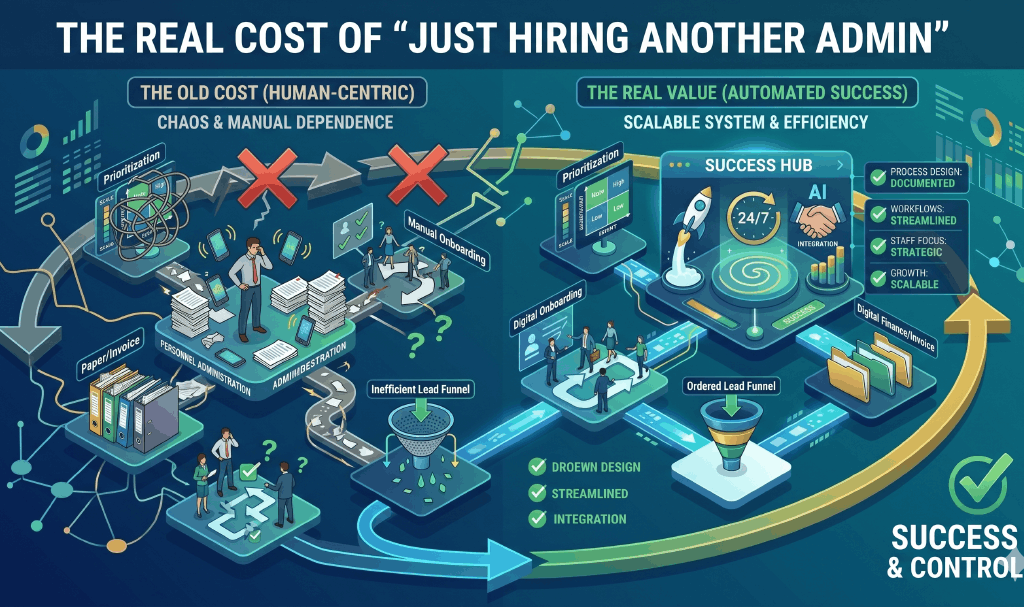

Running an agency has never been easy. Tight deadlines, demanding clients, rising costs, and constant pressure to deliver more with less can quickly squeeze profit margins. Many agencies respond by hiring more people, working longer hours, or cutting prices.
But the most profitable agencies take a different path.
Instead of adding more headcount, they automate internally. And the result is clear: agencies that build automation into their operations consistently outperform those that don’t.
This article explores why internal automation leads to higher profitability—and why it’s becoming a competitive advantage agencies can’t ignore.
The Profitability Problem Most Agencies Face
On the surface, agencies appear busy and successful. Behind the scenes, many struggle with:
- Low margins despite high revenue
- Teams stretched thin
- Work piling up faster than it can be delivered
- Founders stuck in daily operations
The root issue is rarely lack of clients. It’s inefficient internal operations.
Why Hiring More People Doesn’t Fix the Problem
Rising Costs Eat Into Margins
Every new hire adds:
- Salary expenses
- Benefits and overhead
- Training time
- Management complexity
Revenue may grow, but profits often stay flat—or shrink.
More People Create More Coordination Work
As teams grow:
- Communication slows
- Errors increase
- Processes become harder to manage
Without strong systems, adding people adds friction instead of efficiency.
How Internal Automation Changes the Math
Automation doesn’t replace talent—it amplifies it.
When agencies automate internal workflows, they:
- Reduce repetitive work
- Standardize delivery
- Minimize human error
- Free teams to focus on high-value tasks
This directly impacts profitability.
Key Areas Where Agencies Gain the Most
Client Onboarding
Automated onboarding:
- Reduces back-and-forth
- Ensures consistent information collection
- Speeds up project start times
Faster onboarding means quicker revenue recognition.
Project Management and Task Flow
Automation helps:
- Assign tasks automatically
- Trigger updates when milestones are reached
- Keep everyone aligned without constant check-ins
This cuts internal admin time dramatically.
Reporting and Performance Tracking
Automated reporting:
- Saves hours each week
- Improves accuracy
- Gives leadership real-time visibility
Better data leads to better decisions—and stronger margins.
Why Automated Agencies Scale Without Chaos
Growth exposes weaknesses. Agencies relying on manual coordination often hit a wall.
Automated agencies scale more smoothly because:
- Processes are repeatable
- Workflows don’t depend on individuals
- Quality stays consistent as volume increases
This allows revenue to grow without proportional cost increases.
The Hidden Profit Drivers Automation Unlocks
Reduced Burnout
When teams spend less time on repetitive tasks:
- Morale improves
- Retention increases
- Productivity stays high
Replacing burned-out staff is expensive. Automation prevents that cost.
Faster Turnaround Times
Speed improves without sacrificing quality. Faster delivery leads to:
- Happier clients
- More referrals
- Stronger long-term contracts
All of which boost profitability.
Founder Freedom
Automation removes founders from daily firefighting. This allows leaders to:
- Focus on strategy
- Improve sales
- Build partnerships
Profitability improves when leadership works on the business, not in it.
Why Automation Is a Competitive Advantage
Many agencies still operate the same way they did years ago. Those that automate gain:
- Lower operating costs
- Higher margins
- Better client experience
- Stronger scalability
Over time, this gap becomes impossible for competitors to ignore.
Common Myths Holding Agencies Back
- “Automation is too complex”
- “We’re too small to automate”
- “Our work is too custom”
In reality, automation adapts to agencies of all sizes. The earlier it’s adopted, the bigger the payoff.
Conclusion
Agencies that automate internally don’t just work faster—they work smarter. By reducing inefficiencies, improving consistency, and protecting their teams from burnout, they unlock higher margins and sustainable growth.
The result is clear: automation isn’t a cost. It’s a profit multiplier.